

Wire rope is one of the most reliable load-bearing materials in rigging. It’s strong, flexible, and built for demanding environments. But the rope itself is only half the equation. The hardware you choose to terminate, form, and connect everything determines whether the assembly holds. Use the wrong piece and things fail when it matters most.
This is a guide to the pieces that rarely get enough attention: wire rope thimbles, wire rope clips, and how to install them correctly.
What Is the Purpose of a Wire Rope Thimble?
If you’ve ever seen a wire rope termination up close, you’ve probably noticed a teardrop-shaped metal insert sitting inside the loop. That’s a wire rope thimble, and it’s doing more work than it looks like.
Bending wire rope back on itself to form an eye creates significant stress at that curve. Without support, it can flatten, fray, or crush under every load cycle. A thimble sits inside the loop and holds its shape. It distributes pressure evenly around the curve rather than letting it concentrate at one point.
The result is a cleaner, stronger termination that holds its geometry under repeated loading. Attach a shackle or hook to that eye and you’re bearing against the thimble, not the rope fibers directly. That’s exactly how it should work.
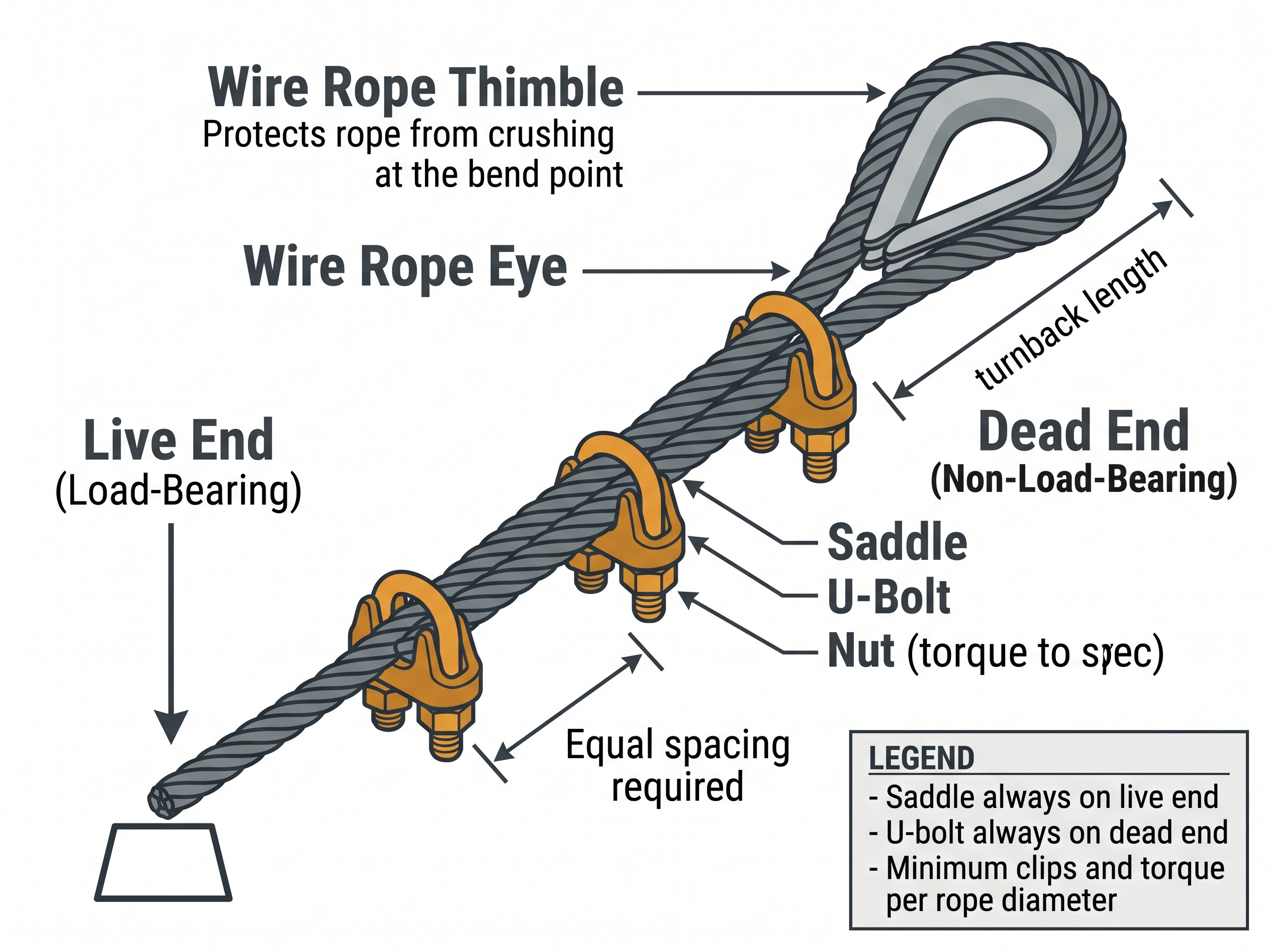
Skipping the thimble is a common shortcut. It costs almost nothing and saves a few seconds at installation. It also shortens rope service life. Failure can happen at loads well below what the rope is actually rated for. Our wire rope thimble fits standard rope diameters and holds up in marine and industrial environments. Corrosion resistance matters in both.
Wire Rope Clips: What They Do and How to Install Them Correctly
A wire rope clip, also called a U-bolt clip or bulldog clip, is the most common way to form a loop or eye in wire rope. No specialized equipment needed. The assembly has three parts: a U-shaped bolt, a saddle, and two nuts. Fold the rope back on itself to create the loop. Position the clip across both rope sections and tighten the nuts to clamp everything down.
Simple enough. But people ignore one installation rule often enough that it causes real problems.
The saddle of the clip must always bear against the live end of the rope, meaning the weight-bearing section. The U-bolt contacts the dead end, which is the short tail folded back. If you reverse this, the U-bolt bears against the live end and can damage or crush the load-carrying wires. There’s an old saying in the rigging trade: never saddle a dead horse. It means never put the saddle on the dead end.
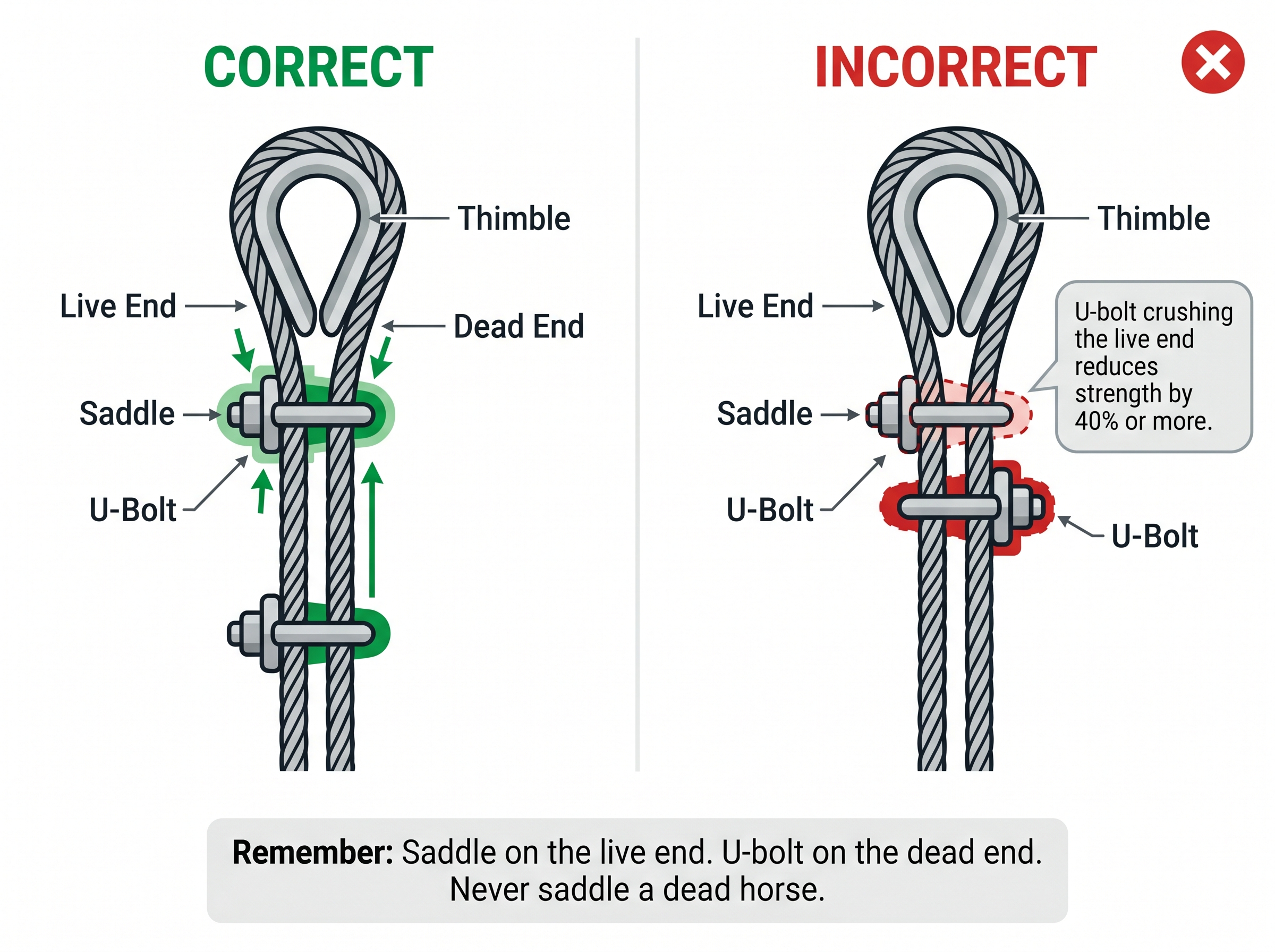
Beyond clip orientation, the number of clips you use and the torque you apply both matter. Using too few clips, or leaving the nuts under-tightened, reduces the holding strength of the assembly significantly. Proper installation with the correct number of correctly torqued clips gives you roughly 80 percent of the rope’s rated strength at the termination point. Cutting corners on either front drops that number fast.
Our wire rope clip is a practical choice for field and shop applications where a reliable, repositionable termination is needed. Because clips can be removed and reinstalled, they’re useful when you need to adjust rope length or reconfigure a rigging setup without cutting new rope.
Drop-Forged vs. Malleable Wire Rope Clips: What’s the Difference?
This is a question worth answering clearly, because the two types are not interchangeable in all situations.
Manufacturers press heated steel into a die under high pressure to produce drop-forged clips. That process creates a dense, uniform grain structure throughout the piece. Malleable clips are cast iron, less expensive, and more brittle. The practical differences go further than that.
| Feature | Drop-Forged Steel | Malleable Cast Iron |
| Manufacturing process | Heated steel pressed into a die under high pressure | Molten iron poured into a mold and cooled |
| Grain structure | Dense, uniform throughout | More brittle, less consistent |
| Load rating | Higher | Lower |
| ASME B30.9 compliant for rigging | Yes | No (prohibited for overhead lifting slings) |
| OSHA approved for overhead lifting sling fabrication | Yes (with restrictions) | No |
| Minimum clips required vs. forged (same rope size) | Baseline | One additional clip required |
| Recommended for marine use | Yes | Not recommended |
| Recommended for industrial rigging | Yes | Light duty / non-critical only |
| Typical cost | Slightly higher | Lower |
| Best use case | Any application where load ratings and compliance matter | Low-load, non-overhead, non-safety-critical setups |
One More Thing Worth Knowing
ASME B30.9 does not approve wire rope clips for fabricating overhead lifting slings. OSHA regulations reinforce that position. If you’re building a sling for a crane hook or hoist, use swaged sleeves or spelter sockets for the terminations. Clips are not the right tool for that job.
For towing assemblies, marine tie-downs, and agricultural rigging, a clip and thimble combination done right gives you a termination you can count on.
We’ve spent nearly 50 years supplying rigging hardware to the people who depend on it every day. Browse our full line of rigging components and wire rope hardware at Henssgen Hardware. If you’re putting together a specific rigging setup and want to make sure you’ve got the right pieces, reach out. We’re glad to help you work through it.
0 Comments